Poetry
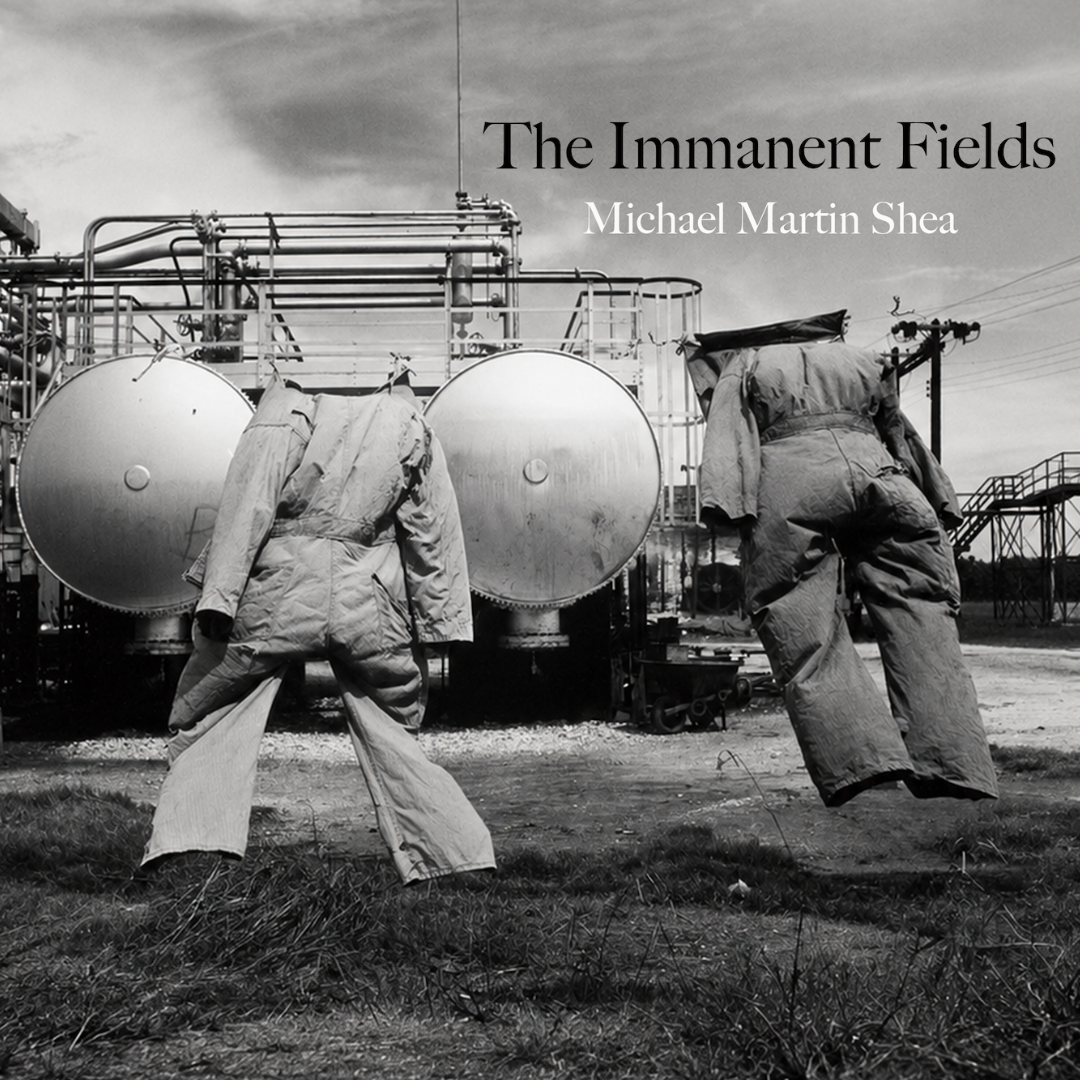
The Immanent Fields
New Mundo Press, 2026
Shea’s is a poetics of velocity—I almost said viscosity and that’s true too. Verb-y and affect-full, the sentence is mad with action (“Green fruits go nuts”; “The bedpan crumbles”; “Piety unspools across the prairies”) and the line swerves hard (“whose roads are these, unpaved, / and so desirous of it—/ balls of prophecy in the nutsack of the real?”). But there is thickness too, an oozy sort of dolor emanating from bodies and objects in a steady state of arousal. The languor of immanence, the lust of simultaneity, thereby the libidinous anti-epiphanic. I am invigorated!
—Aditi Machado
These are poems transmitted from the final phase of lyric consciousness: a voice still singing as it’s dissolved by spectacle, capital, data, desire. Driven by terse, caustic declaratives and a flurry of similes mocking their own existences, Shea’s language machine distributes the body through black-flowered derangements and high-flown philosophical abjections. This feels like an accelerationist poetics, a deeply-textured anti-poetry, an act of psychic vandalism in the moment before we are all unceremoniously subsumed into the borg or the oceans vaporize. A delightful string of literary miscreants came to mind as I read this: Bill Knott, Alan Dugan, William S. Burroughs, Nicanor Parra, and Diogenes, for Lord’s sake. This book sets its teeth into the conceptual absurdities of our glowingly venal drive-thru empire. I would say it doesn’t let go, that it shakes the truth out, or that it transmits its rabidity to the larger social corpus, but this book would mock such predictable rhetorical moves.
—Tim Earley
“I do not think the simile is a sufficiently erotic experience,” declares the unstably ironic, shifty, and utterly intense “I,” of this book, early on. This is in a piece called “OPENING ARGUMENTS,” a good title, because this book theorizes what it does, does as a form of theorizing, theorizes, perhaps, as a form of handling a feeling (of bleak amusement? Burnt affection? Lively anguish?) toward the world. What it is theorizing is also at least partly the problem of mediation: “it is impossible to perceive a single image of the object[…]corresponding directly to the object itself” — and despite its ‘erotic insufficiency,’ the simile’s mediating invitation to see one thing through and as another is completely everywhere in The Immanent Fields: a true form of the book’s lively imbrication with and care for the damaged world it attends to. Desire flows “like” municipal waste, the signifier slips “like” a salmon, hope inflates “like” a carcass, vinyl siding flexes “like” belief, a deranged thought pierces “like” the spirit does. The mood is: pharmaceutical. The ideal geometry is of the dishwasher. Heaven is: of polymers. The anchoress has indeed been “forgotten in the walls,” but she’s in there.
—Kai Ihns
I put my ear up to this rhombus the way I do with the conch. I hear the echo of the quadrilateral; I know the small circulating air is not the ocean. In my mind, the echo of air in the shell provides some momentary comfort. A clean wistfulness. I am similarly arrested within the tessellations of this book’s sticky blab. I, too, want to watch a president die on live TV. I find myself anxiously luxuriating in the spermatozoic seance of Shea’s arrhythmic sequences, wiping the spectral emission from my chest before it dries and the tortures of the day begin, perchance also watching it drip from a hole, an approximate void, our only sense of comfort. "And elevates a phrase not operatic."
—Ryan Skrabalak
Chapbooks

I’m Sorry But None of This Is My Fault
Essay Press, 2025
In the age of Babel where language suffers from misuse, our muse is misuse. Michael Martin Shea’s poems ‘survey dereliction.’ They offer us a stream of the quotidian, the grotesque; an echo chamber of our toxic culture, relentless as existence. Okay fine,’ he says to the horror. But still the poet chases that ‘lunar ache.
—Sara Nicholson
In Adorno’s modernism, the ‘totality of the social’ slips into the art-object, and steadies itself there, protected from discursive reductions. But what if the ‘art-object’s’ (in this case, the poem’s) innards start talking back to its confines, without fear or remorse? I’m sorry but none of this is my fault, the title of Michael Martin Shea’s new book, could not be more apt. With a fencing foil quickness, Shea brilliantly lacerates the boundaries of ideologically vetted poetics by stretching metonymic meaning just shy of the breaking point. The surprising social-psychological entanglements that are revealed make for some of hardest won hilarity of any poetry around.
—Rodrigo Toscano
I’m not sure what these are. At times confession, at times accusation, at times grieving declaration informed by the moral and political ecologies of spectacle, they are also just incomprehensibly weird. And ingenious. And uplifting.
—Gabriel Gudding

To Hell With Good Intentions
Beautiful Days Press, 2024
If William Carlos Williams swallowed a Xanax and three tabs of acid, if he attempted to take a long nap, and if his brain was wired to a contraption that transcribed his bad dreams into poems, they might look a bit like Michael Martin Shea’s placid, euphoric, and horrifying vision of the lyric. In To Hell With Good Intentions, things don’t merely contain ideas; rather, they vibrate like prophetic objects in a televised crime scene, overflowing with the alternate grief and joy of our excessive present—a world filled with burning Amazon vans, airborne Doritos bags, and a humanity that is both knowable and not: “new toes which grew inside you / teeth new mouth new endless revision.” I am in love with Michael Martin Shea’s “beautiful brain” and these violent, gorgeous little poems that crawled like neon worms from its folds.
—Marty Cain

Comparative Morphologies
Above/Ground Press
2018

The Immanent Field
Essay Press
2017

“Soon”
Garden Door Press
2016
Selected Journal Publications
Five poems from Demons Are Real.Chicago Review. 2025.
Five poems from Bad Infinity. Works & Days. 2024.
“[The statue of the rooster has a purpose.]” Cincinnati Review. 2024.
Two poems from Demons Are Real. VOLT. 2024.
“[Am I tormented].” Copenhagen. 2023
“[None of it matters now].” Sixth Finch. 2023.
“When You Weren’t a Boy.” Typo. 2023.
Five Poems from I’m Sorry But None of This Is My Fault. Tyger Quarterly. 2023.
Three Poems from I’m Sorry But None of This Is My Fault. APARTMENT Poetry. 2023.
Three Poems from I’m Sorry But None of This Is My Fault. The Tiny. 2022.
Four Poems from To Hell With Good Intentions. Mercury Firs. 2022.
Three Poems. Afternoon Visitor. 2020.
“Translation.” Fence. 2018.
From Comparative Morphologies. Dusie. 2018.
From The Immanent Field. Western Humanities Review. 2017.
From The Immanent Field. PEN Poetry Series. 2016.
From The Immanent Field. Conjunctions.2015.
From “Hermeneutics.” Prelude. 2015
“The Lake.”The Pinch. 2015.
“The Children.” Jubilat.2014.
Five Poems. Dreginald. 2013.
“Sketch #7.” Colorado Review.2013.
“The Devouring.” Pleiades.2013.
Two Poems. New Orleans Review.2012.
“Speech Therapy.” Salt Hill.2011.